


In 2025, the digital transformation wave has entered deep waters. Enterprises are no longer focused on building experimental cloud-native environments; instead, their core demand has shifted toward platforms capable of supporting mission-critical workloads and scaling business value sustainably. This requires both the power to make bold breakthroughs and the control to steadily master the core.

As an enterprise-grade multi-tenant container platform, KubeSphere is committed to being a reliable partner and a steady vehicle in this transformation journey. By simplifying operational complexity, integrating industry best practices, and delivering production-ready capabilities out of the box, we help global customers manage stable, efficient, and self-controlled application management planes across multi-cloud and heterogeneous environments—accelerating innovation delivery, optimizing resource costs, and ensuring business continuity.
Looking back over the past year, we not only achieved key breakthroughs in product capabilities, but also witnessed the steady realization of platform value in mission-critical scenarios across industries including finance, government, manufacturing, and education.
Product Excellence: Strengthening the Enterprise Foundation
In 2025, we continued refining the product through iterative releases, culminating in the launch of v4.2.1—a milestone that marks a solid step forward toward “exceptional experience and production readiness.” This release and all updates throughout the year focused on addressing the core challenges of large-scale enterprise application management, delivering a more stable and efficient experience across industries.

1. Enhanced Unified Management of Heterogeneous Resources
To address the complexity brought by hybrid architectures, v4.2.1 focuses on building a unified and efficient heterogeneous computing foundation. The platform strengthens unified management and scheduling adaptation for heterogeneous computing resources such as GPU and vGPU, meeting diverse workload requirements from AI inference to graphics rendering.
In addition, through the integration of intelligent data caching acceleration capabilities, I/O latency for storage-intensive applications is significantly reduced. Together, these enhancements provide enterprises with a standardized resource pool across clouds and chip architectures, enabling global coordination and elastic supply of computing resources.
2. Upgraded Elastic Scheduling System
To maximize resource efficiency and optimize costs, v4.2.1 introduces a multi-dimensional intelligent elastic scheduling system. The platform innovatively integrates Vertical Pod Autoscaling (VPA), Horizontal Pod Autoscaling (HPA), and event-driven autoscaling (KEDA) into a unified experience.
VPA automatically optimizes container resource specifications based on historical workloads, reducing over-provisioning.
Enhanced HPA policies allow fine-grained and independent control over scaling behaviors.
KEDA converts external events such as message queues into scaling signals and even supports scaling replicas down to zero for extreme cost optimization.
3. Strengthened Cluster Stability and Governance
To ensure global stability in large-scale, multi-cluster production environments, v4.2.1 delivers significant enhancements in governance and observability.
The newly introduced Node Group capability enables logical grouping of physical nodes and binding them to enterprise workspaces—perfectly supporting complex scenarios such as multi-tenant resource isolation and mixed deployment in secure domestic computing environments.
On the operations side, the platform provides visualized online upgrades for member clusters and precise status synchronization, significantly simplifying multi-cluster lifecycle management.
Global Practices: Deep Engagement in Mission-Critical Scenarios
The ultimate value of a product is proven when users face real-world core business challenges. In 2025, KubeSphere’s reliability, flexibility, and openness earned deep trust across key global industries.
Domestic Implementations
A leading automotive finance company adopted KubeSphere Enterprise Edition to build a unified hybrid cloud platform. While meeting stringent financial compliance and isolation requirements, it achieved global elastic resource scheduling and one-stop operations management, improving overall operational efficiency by over 40% and strongly supporting rapid innovation and stable business operations.
A Municipal Bureau of Planning and Natural Resources built a “One Cloud, Multiple Architectures” government container cloud platform. By seamlessly managing heterogeneous chip architectures and enabling unified cross-architecture scheduling with standardized processes, it effectively supported the digital transformation of smart city and spatial planning systems.
A regional Meteorological and Geophysical Bureau selected KubeSphere Trusted Edition to build the cloud-native foundation for its core forecasting and monitoring systems. While meeting high security and compliance requirements, the platform enabled unified resource scheduling and automated operations, ensuring 24/7 uninterrupted and stable meteorological services.
International Expansion
AMPLUS S.A., a European IT solutions provider, built a standardized cloud-native management solution based on KubeSphere for a public university research platform. This approach significantly reduced long-term operational costs, empowered users with self-management capabilities, and improved solution reusability and delivery efficiency—enabling Amplus to establish a productized service model reusable across education and enterprise customers.
Ecosystem Co-Building: Bringing Industry Together
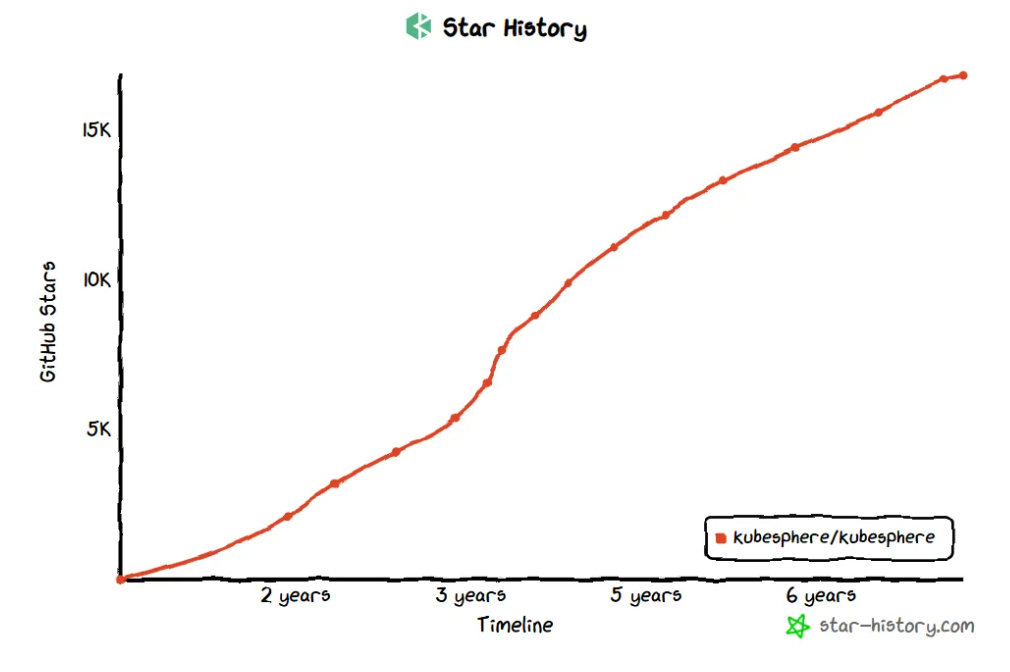
In 2025, KubeSphere’s technical influence and ecosystem recognition continued to grow, with GitHub stars surpassing 16,000—reflecting strong global developer engagement. We remain committed to collaboration and win-win partnerships, building a vibrant technical ecosystem with partners and users.
Cultivating Cloud-Native Talent
Through technical collaborations, joint innovation programs, and talent development initiatives, we established deep partnerships with industry players and universities. Programs such as “Open Source Summer” successfully incubated innovative prototypes like an intelligent operations assistant, accelerating the practical exploration of cutting-edge technologies.
Integrating Industry Best Practices
Through a flexible extension component architecture, we achieved deep integration with leading technologies such as Fluid (data orchestration) and OceanBase (distributed database). This allows users to flexibly select and combine production-proven components to build a robust and reliable infrastructure foundation.
Advancing Technology Integration and Standard Practices
We continue contributing stability and performance optimization experience gained from large-scale enterprise deployments back to the ecosystem, working closely with industry communities to advance the maturity and adoption of cloud-native application management standards.
Looking Ahead: Platform-Based Agile Evolution
To respond more agilely to technological evolution and diverse business scenarios, KubeSphere will adopt a new development model in 2026:Annual core platform updates, with quarterly extension component releases.
This model focuses on strengthening core capabilities and key scenario support while leveraging flexible modular strategies to adapt quickly to market changes—helping enterprises continuously unlock cutting-edge value on a stable foundation.
Our roadmap will focus on four key directions to make the platform smarter, more resilient, and more open:
1. Global Governance and High Availability Assurance
To support global business continuity, we will strengthen multi-cluster federation governance capabilities. A key focus is enabling active-active management planes and disaster recovery by integrating leading solutions such as Karmada, ensuring cross-availability-zone high availability and fault recovery for the control plane itself—providing a solid management foundation for large-scale, geographically distributed deployments.
2. Intelligent Operations and Cost Insights
We will evolve operations from visualization toward intelligence and refinement.
A newly designed global overview dashboard and centralized alert center will provide administrators and tenants with clear visibility into system status and event management.
Building on this, a planned AI-powered operations assistant will analyze alerts, logs, and performance data to provide root cause analysis and remediation suggestions.
In parallel, we will deepen cost insight capabilities by analyzing resource consumption and billing data to deliver visualized cost allocation reports and optimization recommendations—making cloud-native resource costs transparent, controllable, and optimizable, truly enabling cost reduction and efficiency improvement.
3. Ecosystem Integration and Standard Practices
We will deepen integration with leading cloud-native technologies and deliver production-ready solutions while promoting standardization.
Cilium Integration: We will provide a Cilium-based container networking solution built on eBPF, offering higher network performance and observability. Its powerful security policy capabilities—including network policies and service mesh features—better meet enterprise security and compliance requirements.
Adopting Gateway API:As the widely adopted Ingress NGINX gradually moves toward maintenance mode, we will provide next-generation traffic management solutions based on the Gateway API standard. This enables users to smoothly transition from existing Ingress implementations to a more powerful and unified governance framework, mitigating technology obsolescence risks and future-proofing architecture evolution.
These integrations aim to productize community best practices, promote adoption of industry-recognized standards, and reduce technology selection and implementation complexity.
4. Extension of Core PaaS Capabilities
To simplify the cloud-native deployment and management of critical middleware, we will enhance extension components to improve full lifecycle management for container-based databases, message queues, and other middleware—providing one-stop capabilities for deployment, monitoring, and backup, ensuring critical enterprise applications run smoothly and reliably on a unified container platform.
Conclusion
Every breakthrough in 2025 was built on the trust and collaboration of customers, partners, and community members.
Looking ahead to 2026, KubeSphere stands ready with a more resilient foundation and a more agile ecosystem. We invite you to master your digital core and embrace an intelligent and resilient digital future together.
KubeSphere invites you to navigate the digital future together.
